The African Review of Economics and Finance Conference 2026: Owning the Ground Beneath Our Feet
Africa's challenge has never been a lack of resources. The real task is converting what the continent already holds into lasting African wealth. That conviction ran through every session of the African Review of Economics and Finance Conference (AREF 2026), held at Wits Business School in Johannesburg from 12 to 14 October 2026 under Conference Chair Prof. Jones Odei-Mensah.
Under the theme "Owning the Ground Beneath Our Feet: Resource Sovereignty, Monetary Independence, and the Architecture of African Wealth", scholars, policymakers, founders and industry leaders gathered for three days of keynotes, panels and research presentations. Here are the key insights from AREF 2026.
Day 1: PhD and Early Career Researcher Forum
AREF 2026 opened with a full day dedicated to the next generation of African scholars, focused on building research careers in and from Africa.
Becoming an Independent Scholar in and from Africa
Moderated by Dr Emmanuel Silva Quaye (Wits Business School), the opening panel explored how doctoral researchers can develop a distinctive scholarly identity, build a coherent research programme and position their work within African and international debates. The panellists were:
- Prof. Chimwemwe Chipeta (Wits School of Economics and Finance)
- Prof. Oliver Takawira (University of Johannesburg)
- Prof. Paul Issock (Wits School of Business Sciences; AfOx Fellow, University of Oxford)
- Prof. Pontso Moorosi (Wits Business School)
Navigating the Early Academic Career
Facilitated by Dr Robin Drennan, a second panel tackled the practical transition from doctoral study to an academic appointment. It covered balancing research and teaching, supervision, finding mentors and collaborators, and securing research funding. The panellists were:
- Dr Simeon Coleman (Loughborough University)
- Prof. Jabulile Msimango-Galawe (Wits Business School)
- Prof. Godfred Amewu (University of Ghana Business School)
- Dr Kingsley Okere (Wits School of Economics and Finance)
Research Development Colloquium
After a briefing by Dr Sylvester Horvey on presenting and defending research, doctoral and early-career researchers presented work in progress at a colloquium chaired by Prof. McEdward Murimbika. Discussants Dr Semukele Mlotshwa, Dr Yemisi Adelakun and Dr Ephrem Akilimali gave structured feedback on contribution, theory, method and publication potential. The day closed with a conversation with journal editors on turning doctoral research into published work, followed by a networking cocktail hosted by the Wits Crucible Centre for Entrepreneurship.
Day 2: Resource Sovereignty, Leadership and Building from the Ground Up
Setting the Institutional Vision
After a welcome from Conference Chair Prof. Jones Odei-Mensah, Prof. Logan Rangasamy (Interim Director of Wits Business School) formally welcomed delegates, emphasising regional monetary independence and strong local institutional governance. Prof. Jason Cohen (Dean of the Faculty of Commerce, Law and Management, Wits) then set the tone: "Africa's challenges are not a lack of resources." The continent holds 65% of the world's uncultivated agricultural land and its largest youth population, so the work ahead is converting existing assets into African wealth.
Academic Keynote: Economic and Knowledge Sovereignty in Africa
In his keynote, "Owning the Ground Beneath Our Feet: The Conference Theme in Continental Perspective", Prof. Imhotep P. Alagidede (Wits Business School; Bank of Ghana Chair in Finance and Economics, University of Ghana) argued for full monetary and intellectual sovereignty, and for African control over the extraction of its raw materials. Quoting a Swahili proverb, "He who wants what lies beneath must bend for it", he stressed that Africa must build financial architectures backed by its own verified production. He also called for integrating indigenous wealth models such as stokvels, and for African institutions to publish their own research so the continent controls its own narrative.
Africa's Leadership Imperative
Prof. Maurice Radebe (Director, Faculty of Commerce, Law and Management, Wits) delivered a direct challenge: "Africa doesn't have a resource problem; it has a leadership problem." He argued that true sovereignty demands disciplined negotiation and long-term stewardship that outlasts five-year political cycles. As he reminded the room: "You get what you negotiate in life, not what you deserve."
Digitising Informal Credit: From Classroom to Fintech
In a standout presentation, Teboho Twala (Founder and CEO, Zakhaa Pay, and PhD Candidate, Wits) traced his journey from the Master of Management in Entrepreneurship and New Venture Creation (MMENVC) classroom at Wits Business School, under the supervision of Prof. Jabulile Msimango-Galawe, to building a fintech venture with a Tier-2 banking licence.
Inspired by his grandmother's 1986 micro-enterprise, he showed how Zakhaa Pay integrates deferred payments into smart card terminals. By digitising informal credit, micro-businesses build verifiable transaction histories that help them access bank funding and stabilise cash flow. It is a practical example of digital financial inclusion in South Africa.
Parallel Academic Sessions
Across ten tracks, researchers presented work on value addition and industrial transformation, indigenous knowledge systems, productive entrepreneurship, risk and insurance, the just energy transition, digital enterprise, gender and development, philanthropy and non-profit capacity, and financial market architecture. Highlights included:
- Kurauone Dennis Mhangami presented "Business Model Innovation Under Adversity: A System-Completing Perspective from Emerging Markets" in Track 3.
- Palesa Mary Mofokeng presented "Small Organisations, Big Work: Founder-Led Nonprofits, Philanthropic Constraints, and Everyday Innovation in South Africa" in Track 9.
- Israel Notwane-Skosana presented "From Knowledge Extraction to Knowledge Sovereignty: Indigenous Knowledge, Intellectual Resources, and the Architecture of African Wealth" in Track 2.
Practitioner Perspectives: Building African Ventures at the Nexus
Day 2 closed with a panel moderated by Dr Mahad Moti, featuring:
- Dr Belinda Rathogwa (Standard Bank)
- Ekundayo Oladapo (Panacea Trading)
- Xitlhangoma Dugmore Nkanyane (Interflex Capital)
- James Matodzi Nesongozwi (Manngwe Mining)
- Teboho Twala (Zakhaa Pay)
The panellists grounded economic theory in operational reality, debating how African ventures navigate capital constraints and infrastructure gaps while retaining local value.
Day 3: Gender Equity, AI Infrastructure and Youth Employment in Africa
Academic Keynote: Gender and the African Development Contract
Prof. Nkechi S. Owoo, the first woman to become a full Professor of Economics at the University of Ghana, delivered a challenging keynote on the flaws in standard economic measures such as GDP and employment rates. These measures overlook unpaid care work, how resources are shared within households, and time poverty. She made three central points:
- Care infrastructure is economic infrastructure. Unpaid care absorbs vast amounts of women's time across sub-Saharan Africa. Spending on water, sanitation, transport and childcare should therefore be budgeted as core economic infrastructure.
- Employment metrics fall short. Counting whether women are employed does not reveal whether they control their earnings, hold secure property rights or face physical vulnerability.
- Shared prosperity needs five tests. She proposed five benchmarks for inclusive growth: Resources, Agency, Time, Well-being and Safety, and Resilience and Inclusion.
"Employment tells us whether a woman has a job. It doesn't tell us whether the work actually works for her. We cannot fully own the ground beneath our feet until we value the hands that nurture it." ~ Prof. Nkechi S. Owoo
AI, Innovation Policy and Digital Public Infrastructure
Prof. Rennie Naidoo (Professor of Information Systems, Wits School of Business Sciences, and Establishment Lead of the Wits MIND Investec Chair in Artificial Intelligence and Sustainable Business Transformation) facilitated a roundtable that examined AI as multi-layered national infrastructure, from minerals and data centres to digital public platforms.
- Prof. Naidoo framed the tech sovereignty challenge. Africa supplies the raw materials at the base of the global AI stack, but it must capture value higher up by building local digital capability.
- Prof. Stella Bvuma (Director, School of Consumer Intelligence and Information Systems, University of Johannesburg) addressed vendor dependency and data risk. She urged governments to negotiate procurement terms that foster local SME inclusion.
- Prof. Yudhvir Seetharam (Wits School of Economics and Finance and Chief Analytics Officer, FNB Commercial) cautioned against adopting AI simply to "keep up with the Joneses". He called for a focus on grassroots problem statements and ethical human oversight.
- Prof. Sunet Eybers (School of Computing, UNISA) shared insights on human-centred design and generative AI policy in higher education. She also discussed the subtle ways digital systems can exclude marginalised communities.
CAPSI Plenary: Philanthropy, Social Investment and Youth Employment
In a plenary facilitated by Dr Dennis Boahene Osei (Research Manager), the Centre on African Philanthropy and Social Investment (CAPSI) presented preliminary findings from its 17-country, Mastercard Foundation-funded study. The study has so far surveyed over 20,000 young people across 15 countries.
- Indirect versus direct impact. Roughly 1 in 4 young people had received work directly from a non-profit. The sector's contribution was found to be largely indirect, through skills training, entrepreneurship support and scholarships.
- Purpose versus pay. Dr Asiphe Mxalisa (Principal Researcher, CAPSI) drew on African feminist and intersectional perspectives. She noted that non-profit work scores highly on respect and purpose but lags on pay and income reliability, stressed that dignity cannot substitute for decent pay, and urged that youth be treated as partners rather than recipients.
- Institutional evolution. Dr Eleanor Chipeta (Lecturer in Entrepreneurship, Wits Business School) urged non-profits to think like institutions. She called on them to build full enterprise ecosystems and to measure long-term economic security, not just skills interventions.
- Digital skills and innovation. Palesa Mary Mofokeng (PhD Candidate) presented research on digital skills non-profits preparing youth for an AI-assisted labour market. She urged funders to share risk and to make room for failure in innovation programmes.
Parallel Academic Sessions
Nine Day 3 tracks covered social investment and impact measurement, institutions and economic sovereignty, trade and value chains, productive entrepreneurship, green finance and youth pathways to dignified work. Highlights included:
- Elelwani Mudau (Finance Officer: Procurement and Assets, Wits Business School) presented "Financial Innovation and the Digital Revolution: Reimagining African Wealth through Digital Financial Sovereignty" in Track 12.
- Dr Eleanor Chipeta presented "Nonprofit employment pathways and youth employment quality in Southern Africa" in Track 11, chaired by Dr Asiphe Mxalisa, and chaired Track 17 on youth agency and non-profit pathways to dignified work.
- Prof. McEdward Murimbika presented "The African Reposition Theory of Industrial
Practitioner Studio: From Incubation to Scale
Day 3's academic programme ended with the Practitioner Studio, hosted by the Wits Crucible Centre for Entrepreneurship and facilitated by Prof. McEdward Murimbika, its Director. It began with a masterclass on business model innovation and ended with a panel of founders who had lived it.
Masterclass: Business Model Innovation for African Ventures
Kurauone Dennis Mhangami (Founder and CEO, The Startup Coach; PhD Candidate, Wits Business School; venture builder, Wits Crucible) argued that owning the ground beneath our feet means more than holding land, minerals or capital. It means being able to turn Africa's resources, talent and opportunities into enterprises that create and retain value locally.
Drawing on Steve Blank's definition of a startup as a temporary organisation in search of a repeatable, profitable and scalable business model, he made several points:
- Every business model must pass four tests. It has to be desirable to customers, feasible to deliver, financially viable and sustainable.
- Innovate the model, not just the product. Competing on product features alone becomes an arms race that drives up costs and squeezes margins. Changing how a business creates, delivers and captures value is a stronger strategic lever.
- Business model innovation is especially relevant in Africa. African ventures face resource constraints, infrastructure gaps, fragmented markets and limited access to finance, so they can't rely on large R&D budgets.
- Ventures move through five stages. These are incubate, validate, build, scale and renew, and the business model changes at each stage.
- Quality of revenue matters. Recurring or contractual revenue is worth far more than transactional revenue, which keeps a business chasing customers. Unit economics and cash flow are equally critical.
- Scaling requires five shifts. Founders must move from assumptions to evidence, from product to value, from revenue to sustainable economics, from founder dependence to organisational capability, and from growth to scalability and resilience.
Using agriculture as an example, he urged founders to move beyond selling raw commodities and add value at home. By the time African mangoes become juice on a UK shelf, much of their value has been captured elsewhere. His closing message was that the business model you start with may not be the one you scale.
Founder Panel: How Business Models Evolve in Practice
Moderated by Mhangami, four founders and operators shared how their business models have changed since launch:
- Ndabenhle Ntshangase (Co-founder, AirStudent) described how AirStudent, founded in 2017, began in a university residence, grouping students to secure travel discounts. After graduation, the seasonal nature of student travel forced a pivot to events, conferences and SMEs. The business now runs as a franchise, and he has moved into construction, managing heavy machinery at 96% uptime. His view is that AI will erode many tech advantages, so the future of business is physical. His advice to founders was to sell to the person who actually gets the value, which is not always the person in front of you.
- Viwe Bomela (Senior Manager: Commercial, Delivery Ka Speed) traced the company's journey from delivering food by bicycle during COVID to a pivot into parcel logistics, as food delivery margins proved too thin. The business grew from one warehouse to seven nationally and hires drivers from the townships it serves. This year it is shifting from national reach to local delivery hubs, including in Soweto.
- Mukundi Lambani (Founder and CEO, Ambani Africa) shared how an app teaching children African languages struggled because parents valued it but wouldn't pay for it. Ambani Africa evolved into language technology, building translation and voice tools for universities, government and healthcare. Fieldwork in rural KwaZulu-Natal taught the team not to be "a technology in search of a problem": schools wanted posters and books in their own languages, not devices. On balancing impact and sustainability, she said a business can never be poor enough to help the poor.
- Cikizwa Mabo (Lead Founder and CEO, Likhaya; Wits Crucible Entrepreneur) described a pivot in the funeral services sector. The original plan was to offer concierge services to families. Because funeral parlours control access to customers, Likhaya is now building an operating system to replace paper registers and whiteboards in funeral parlour branches.
The session closed with advice for founders. Aim for effectiveness before efficiency, build resilience, and ask for help. As Mhangami noted, there is almost always someone in your network who can make a warm introduction.
Wits Crucible Founders Exhibition
Running throughout all three days, the Wits Crucible Founders Exhibition gave delegates direct access to founder-led ventures and emerging enterprises supported by the Wits Crucible Centre for Entrepreneurship, showcasing pathways from incubation to scale.
AREF 2026 Awards Ceremony and Conference Closing
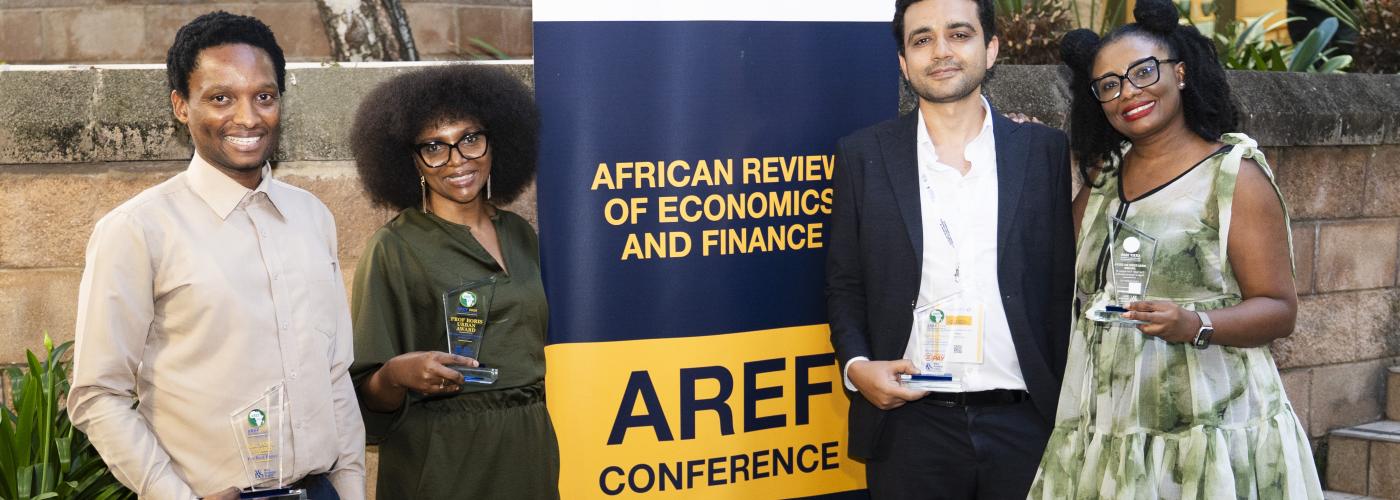
AREF 2026 closed with an awards ceremony recognising outstanding research presented across the three days of the conference. Four awards celebrated scholarship that advances economic understanding, entrepreneurship, financial inclusion and digital transformation in Africa.
Augustin K. Fosu Award for Best Paper in Economics and Finance
Named in honour of Professor Augustin Kwasi Fosu, whose scholarship has made significant contributions to development economics in the African context, this award recognises excellence in economic and financial research. It celebrates work that demonstrates intellectual rigour, originality and relevance to Africa’s development challenges.
Winner: Israel Notwane-Skosana, for “From Knowledge Extraction to Knowledge Sovereignty: Indigenous Knowledge, Intellectual Resources and the Architecture of African Wealth”
The paper speaks directly to the conference theme, raising important questions about African knowledge ownership, intellectual resources and the foundations of sustainable wealth creation.
Teboho Twala Award for Fintech Innovation and Digital Financial Inclusion
Sponsored by Zakhaa Pay, this award recognises innovative research that advances financial technology, digital innovation and financial inclusion in Africa. It celebrates the role of technology in expanding economic opportunity and transforming financial services.
Winner: Ramy Abdelmohsen, for “Beyond Hard Infrastructure: Soft Infrastructure and Digital Readiness in Intra-African Trade Corridors”
Mercedes Da Silva Award for Agile Enterprise and Digital Transformation
Sponsored by 24 Solutions, this award recognises outstanding research on enterprise transformation, digital adoption and organisational innovation. It celebrates scholarship that helps us understand how businesses and individuals navigate technological change, and how digital transformation can contribute to inclusive economic development.
Winner: Lerato Mogale, for “Digital Entrepreneurial Orientation and Digital Self-Efficacy: Complementary Foundations for Digital and Sustainable Solutions in African High-Growth Ventures”
Prof. Boris Urban Award in Digital Entrepreneurship and Innovation
Named in honour of Professor Boris Urban, inaugural Chair in Entrepreneurship at Wits Business School, this award recognises outstanding contributions to entrepreneurship and innovation research. It celebrates work that deepens our understanding of entrepreneurial activity, innovation and the conditions needed for business success.
Winner: Dudu Mpokela, for “Influence of Perceived Tax Administrative Burden on SME Entrepreneurial Success in Gauteng, South Africa”
Key Takeaways: The Future of African Wealth
Across three days, the topics ranged widely: building research careers from Africa, monetary sovereignty and leadership, digitised informal credit, unpaid care work, AI infrastructure, youth employment and business model innovation. Yet AREF 2026 arrived at one conclusion. Economic sovereignty in Africa requires an integrated ecosystem in which academic research, capital, policy and grassroots enterprise work in unison. Africa's economic future will be defined by those willing to build, negotiate and own the ground beneath our feet.
Thank you to all our convenors, speakers, researchers, panellists, delegates and international visitors for making AREF 2026 an extraordinary conference.
Related News